UN beyond 80: An opportunity to position multilevel collaboration and urbanization to save multilateralism and sustainability

The United Nations marked its 80th anniversary in 2025. Over time, numerous UN Secretaries-General have sought reforms of the UN system, but were unable to achieve more than incremental progress due to limited buy-in from Member States.
This year is different.
The question is no longer whether the system needs reform, but whether it can deliver significant enough reform in time. With just four years until the review of the 2030 Agenda, the negotiations on what comes next will shape not only the future of sustainability, but also the credibility of the multilateral system itself. In a world shaped by overlapping crises – armed conflict, climate, biodiversity, inequality, and technological disruption – the gap between global commitments and real-world delivery is becoming almost impossible to ignore.
But this is not due to a lack of ambition – it is due to a lack of alignment.
The UN80 Initiative – an ambitious, system-wide reform effort – as well as the reform of the United Nations Economic and Social Council (ECOSOC) and the High-Level Political Forum, the review of the New Urban Agenda and SDG 11, the push for stronger synergies across the Rio Conventions, and the transition toward new UN leadership are all unfolding at once. The challenge is whether they can be composed into a coherent system for action, or remain fragmented efforts in an increasingly complex global landscape.
UN-wide reforms process: A portfolio of notes waiting for a composer to turn into a symphony
The Secretary-General of the United Nations, António Guterres – who will leave the position in December 2026 –, launched the UN80 Initiative to make the UN system more agile, integrated, and fit for today’s overlapping crises. The process also built on the outcomes of the Summit of the Future in 2024.
The start of the process happened to coincide with the beginning of the second Trump Administration in early 2025. The plan for the UN80 Initiative included budgetary implications amongst others, and it gradually transformed into a three-track process, focusing on administrative changes, options for redesigning existing institutions and opening the space for a more holistic system-wide approach.
The process reached a new momentum with the historic resolution of the UN General Assembly in March 2026, which introduced a strong support from UN Member States to the effort of the UN Secretary-General and extended the process until April 2027.
The ongoing reviews of the UN Economic and Social Council (ECOSOC) and the UN High-level Political Forum on Sustainable Development (HLPF) point in that same direction but through slightly different mandates and processes. While ECOSOC is the main UN body since 1945 covering all issues related to development, HLPF was created in 2015 to lead the 2030 Agenda for Sustainable Development. It merged the Commission for Sustainable Development under Agenda 21 – led by the environmental community since 1992 – and the Millenium Development Goals – dominated by economic and social actors since 2000. Joint review of ECOSOC and HLPF is especially important as the global community has to decide on the modalities for sustainable development beyond 2030, which is the target year for Sustainable Development Goals.
This July will herald the review of SDG 11 on Sustainable Cities and Communities by the HLPF and the midterm review of the New Urban Agenda by the UN General Assembly – two particularly important moments for the urban community. Until the inclusion of a dedicated goal for cities among 17 Sustainable Development Goals in 2015, urbanization was not considered part of sustainable development by the national governments and the UN system under Agenda 21.
Similarly, the HABITAT II community evolving since 1996 did not relate itself to sustainability until the New Urban Agenda in 2016. It would be desirable that with these two separate, consecutive and parallel reviews in July, a more systematic approach to converge urbanization and sustainable development can be established as one of the concrete inputs in the UN reforms package.
The UN reforms agenda is an opportunity for the environment community as well. For decades, global environmental governance was scattered around the Conference of Parties (COPs) of numerous multilateral environmental agreements, in particular of the three Rio Conventions on climate (UNFCCC), biodiversity/nature (CBD) and desertification/land (UNCCD), the UN Environment Assembly and the overall sustainable development community under the HLPF.
The Work Package 27 on Environment under UN80 Initiative to be led by UNEP and the UNFCCC could conclude this long overdue synergy process, building on ongoing efforts such as the CBD’s Bern Process, the UNCCD’s efforts and the Riyadh Action Agenda, as well as UNFCCC´s Action Agenda and COP30 Global Implementation Accelerator and reach to renewed modalities that are embedded into the overall UN reforms package.
Progress and, more importantly, the implementation and follow-up from 2026 onward of all these processes, will be shaped by the selection of the next UN Secretary-General, expected to take office in January 2027. Efforts are evolving from a diversity of Member States, the Presidency of the UN General Assembly, the UN SG Office and civil society that ensure transparency and accountability in the selection process which heavily depends on the veto power of the five Permanent Members of the UN Security Council, as well as high expectations for a female leader to take this helm for the first time in the history of the United Nations.
Non-UN processes: For good or for worse
If the formal multilateral system is under pressure, it is no surprise that alternative processes are emerging around it.
Some examples are positive – such as the The Fossil Fuel Non-Proliferation Treaty Initiative and the upcoming First Conference on the Transition Away from Fossil Fuels – a coalition of willing nations coming together outside of the climate negotiations process to drive forward the transition, which was a part of the outcomes of COP28.
But other examples seek to undermine the UN. The Board of Peace was organized outside the UN system and endorsed only in limited terms by the UN Security Council to coordinate reconstruction efforts in Gaza, and is an example of exclusive processes, which has yet to prove its effectiveness, taking into account consequences of escalation of military conflicts in the Gulf came after the launch of the initiative in early 2026.
At the same time, initiatives such as the Article 109 Coalition move in a slightly different style and direction. Rather than bypassing the UN system, they call for its review, operate on the provisions of its Charter, and update reflecting on the changing realities of the world. They argue that the current institutional architecture can no longer absorb the pressures placed upon it.
Seizing the time for multilevel collaboration and urbanization
This is precisely where local and regional governments matter, not as symbolic participants, but as institutional connectors.
Since 2012, the Global Taskforce of Local and Regional Governments, where ICLEI is a founding member and leads actively as its focal point to the Rio Conventions related processes, has shown what coordinated self-organization can achieve. It has unified a constituency, created common advocacy positions, and enabled more structured engagement across UN processes. The good practice in engaging with the UN Secretary-General’s Advisory Group on Local and Regional Governments built on that momentum and produced a strategy for more permanent and structured engagement of local and regional governments in intergovernmental processes and UN political bodies, which is actively presented at the ECOSOC/HLPF review process.
Another practical entry point into the UN system is the Forum of Mayors under the UN Economic Commission for Europe, format and impact of which have significantly evolved since its inception in 2020. Innovative practices like Forum of Mayor and proactive proposals of Global Task Force for constituency-based engagements should be seen as complementary efforts that can be discussed with Members States and partners within the UN system partners to ensure multilevel collaboration is appropriately reflected into the UN reforms packages.
The Local Governments and Municipal Authorities (LGMA) Constituency to the UNFCCC has been one of the good practices in constituency-based engagement in the UN system and shape the evolution of global climate governance by demonstrating that multilevel collaboration and urbanization as two-sides of the same coin to advance climate emergency action. Its COP30 Position – endorsed by more than 50 networks of local and regional governments from around the world – already made clear the relevance and importance of this, with a call to connect the COP30 outcomes to the UN80 reforms, for a new era for multilevel cooperation in the global climate and sustainability agenda. The LGMA has also wholeheartedly supported the Coalition for High Ambition Multilevel Partnership (CHAMP) launched at COP28 in Dubai in 2023 and since then, actively supported its implementation as well as advancing its governance and implementation. The CHAMP experience – where national governments commit to collaborate with their local and other subnational governments in design and implementation of national plans – can be considered as a good practice in evolving the UN system towards enhanced multilevel collaboration.
As part of UN75 consultations in 2020, ICLEI released a blueprint with four concrete proposals for UN reforms to enhance collaboration with local and regional governments and advanced it further in 2022. In 2025, ICLEI’s first Annual Review of Local and Subnational Action on the Rio Conventions confirmed how urgent this is. Climate, biodiversity, and land are converging. Governance is becoming more complex. Innovation is increasingly happening below and beyond formal structures. And local and regional governments are where this convergence is already being managed in practice, through land use, infrastructure, food systems, ecosystems, risk management, and public services.
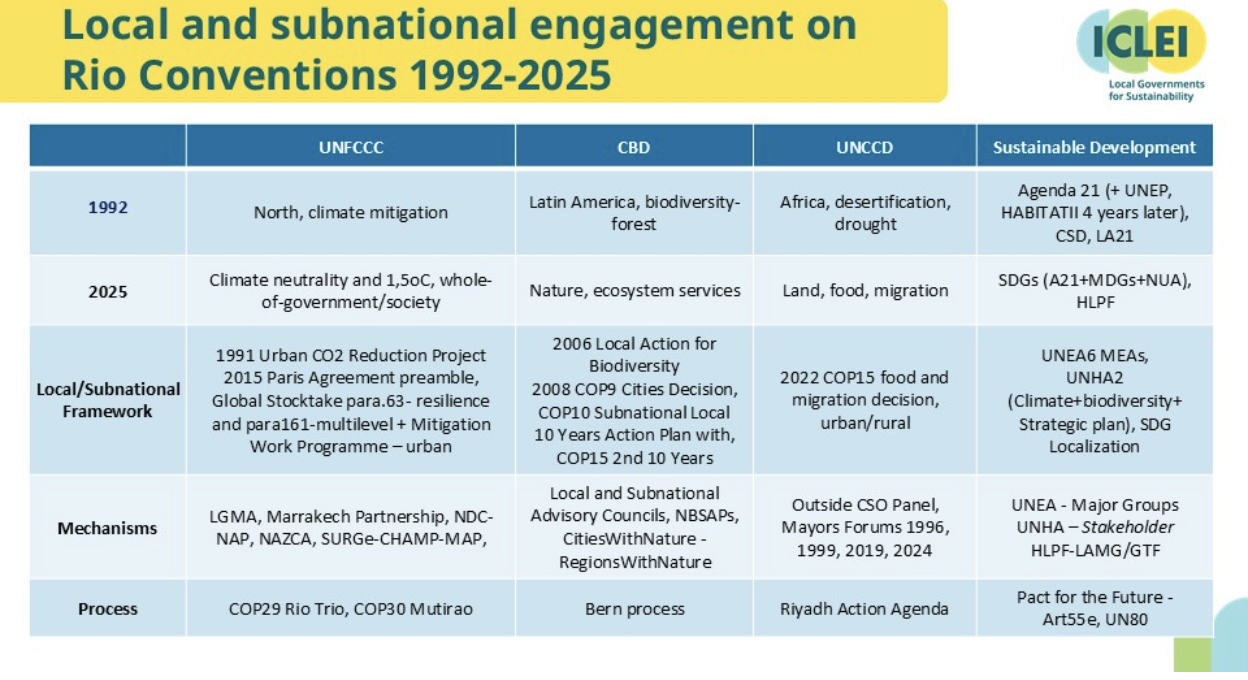
This is why urbanization matters. Cities are where sustainability becomes operational. To safeguard multilateralism and sustainability, local and regional governments should be integrated as governance partners.
Why convergence matters
If multilateralism is to survive this period, it can do so by building on the achievements and principles of the previous era, such as the 2030 Agenda for Sustainable Development with its focus on inclusivity, transparency, ambition, while complementing it with emerging concepts like multipolar, multilevel, decentralized, collective, renewable, shared and fair systems and processes.
A reform of the UN is not only because the UN has expanded from 51 to 193 Member States since 1945, but because its mission has also expanded far beyond peace and security into sustainable development, finance, climate, urbanization, and human rights.
That is why the UN reform discussions cannot be treated as an administrative exercise – it is about whether the UN can respond to overlapping crises with institutions designed for another era.
In this sense, reforming the UN is not only about making the system run better. It is about defining what the system is for. It is also about whether reform will remain sectoral and partial, or become systemic and strategic.
The years ahead offer a rare opening. UN reforms, the post-2030 agenda, the Rio Conventions, the New Urban Agenda, and the transition to a new UN leadership are all moving at once. This can lead to confusion, duplication, and fragmentation. Or it can become a moment of political composition.
And that composition needs a theme, then we suggest: Multilevel collaboration and urbanization are not side issues in the future of multilateralism. They are among the conditions for saving it.
The question is no longer whether the world needs more coordination. It does. The question is whether this can be composed into a coherent symphony for action, or whether they will remain fragmented notes in an increasingly dissonant global system.

Comments
Post a Comment